
Website Page / Photo: xdlab.net
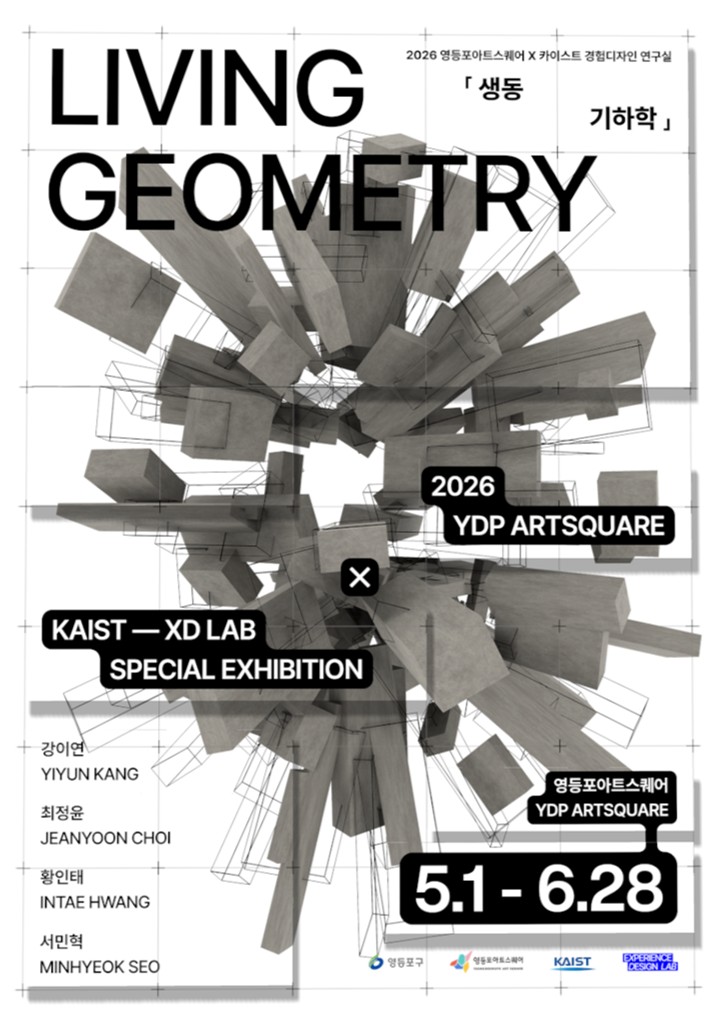
《Living
Geometry 2026》, currently on view at Yeongdeungpo
Art Square, is a media art exhibition conceived and developed by the Experience
Design Lab (XD Lab) of the Department of Industrial Design at KAIST.
The exhibition
approaches the city not as a fixed physical space, but as a dynamic living
system in which humans, technology, ecology, and data overlap and interact.
Yeongdeungpo is a
place where industrial history, financial infrastructure, and cultural
experimentation coexist. Taking this complexity as its point of departure,《Living Geometry》redefines the city as an
organic entity animated by the intertwined relationships among humans, nonhuman
actors, and technological systems. The exhibition consists of three
single-channel video works, three interactive installations, and one
multi-device web-based artwork, featuring works by Yiyun Kang, Jeanyoon Choi,
Intae Hwang, and Minhyeok Seo.
A New
Way of Reading the City
Today, cities can
no longer be understood simply as collections of buildings, roads, residential
areas, and commercial districts. They are complex urban systems shaped by human
mobility, data flows, economic value, ecological environments, and technological
infrastructures.《Living Geometry》proposes the notion of a “living geometry” as a framework for
understanding the complexity of contemporary urban systems.
Here, geometry
does not refer merely to static forms or mathematical order. Instead, it
signifies a constantly evolving structure of relationships. Human movement,
weather patterns, urban data, real-estate values, technological systems, and
ecological crises all become invisible lines and planes that compose the city.
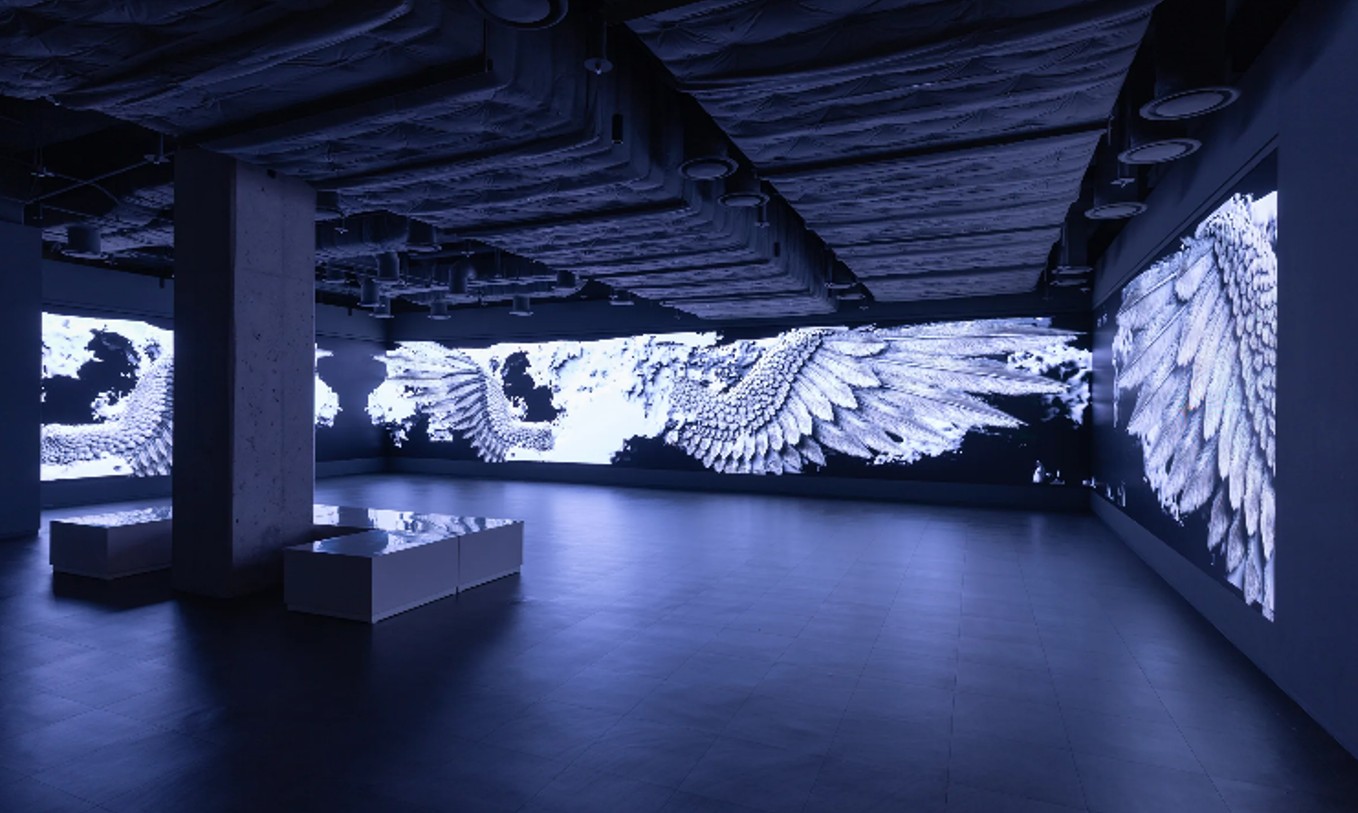
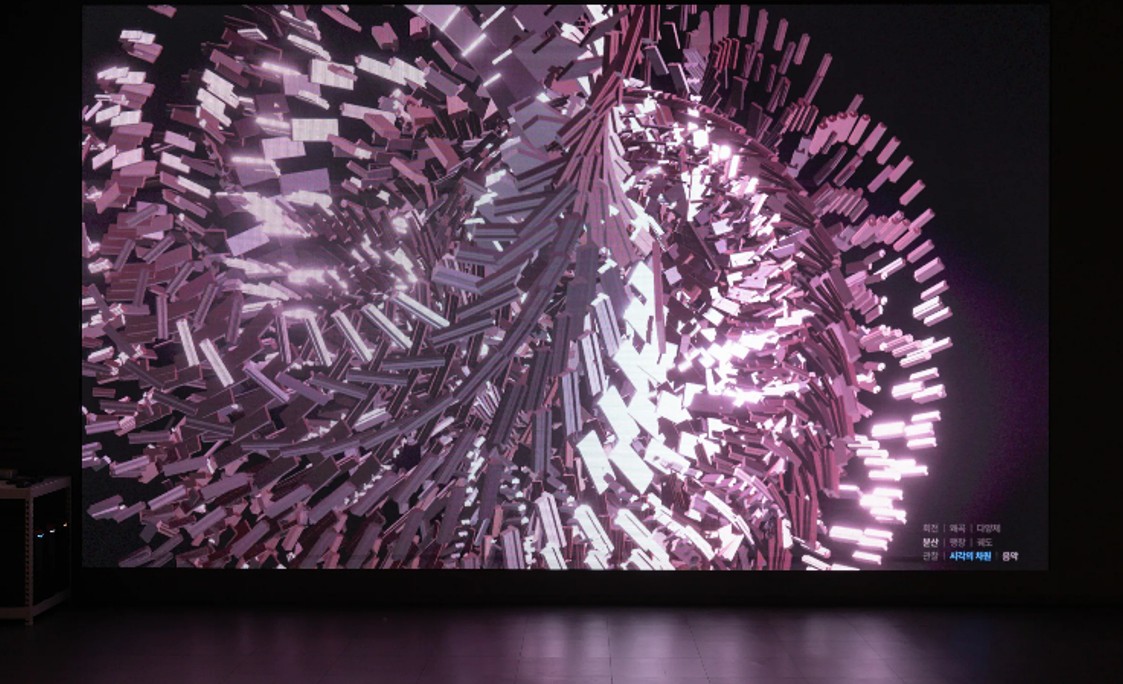
Yiyun Kang, Minhyeok Seo, Amanda Zeline, and Youan Kang, Vanishing 2.0, 2025. Single-channel video with sound, 3 min. 30 sec. / Courtesy of KAIST XD Lab.
1. Vanishing
2.0 : The Sixth Mass Extinction
Vanishing
2.0 is a single-channel video work
addressing the sixth mass extinction currently being accelerated by human
activity. Created collaboratively by Yiyun Kang, Minhyeok Seo, Amanda Zeline,
and Youan Kang, the work visualizes the ecological crisis of the Anthropocene
through disappearing species. Its dazzling digital imagery functions not merely
as spectacle, but as a device that prompts reflection on the traces and
responsibilities human civilization has left upon the natural world.
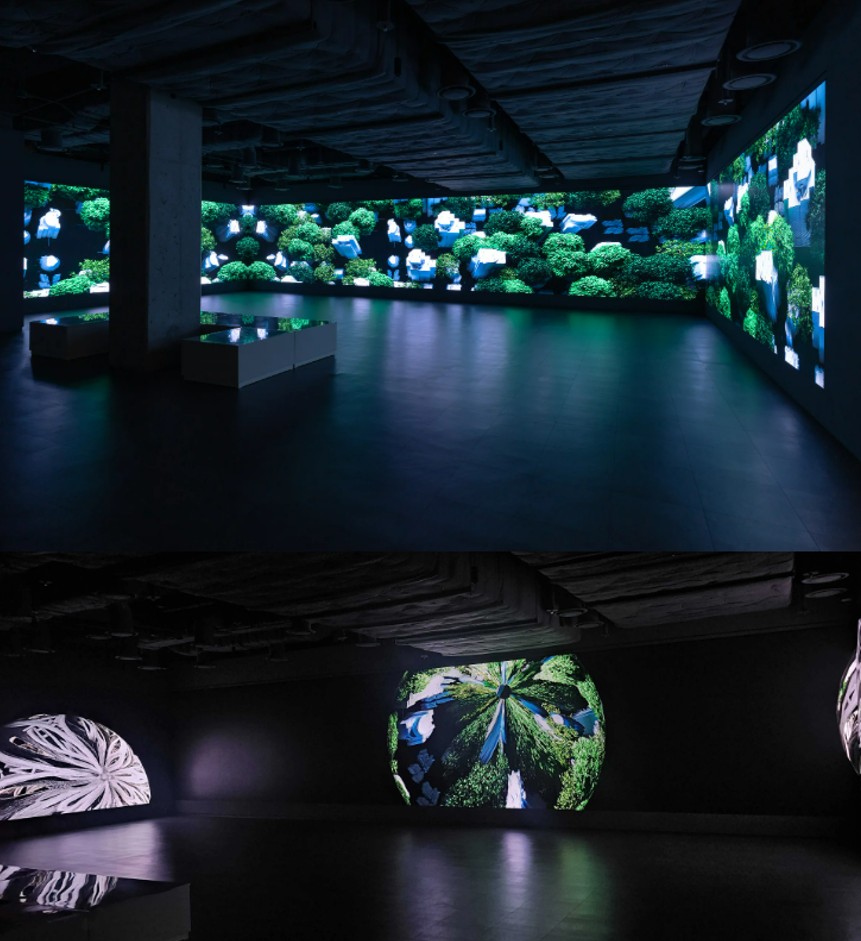
Yiyun Kang, Technosphere, 2026. Single-channel video with sound, 2 min. 07 sec. / Courtesy of KAIST XD Lab.
2. Technosphere :
The Technological Environment Created by Humanity
Technosphere explores the technosphere as a new planetary environment created by
human activity. Through this work, Yiyun Kang demonstrates how roads,
architecture, communication networks, data centers, and energy infrastructures
have become inseparable components of both urban life and the planetary
environment. The work examines how this technosphere reshapes nature and human
existence alike.
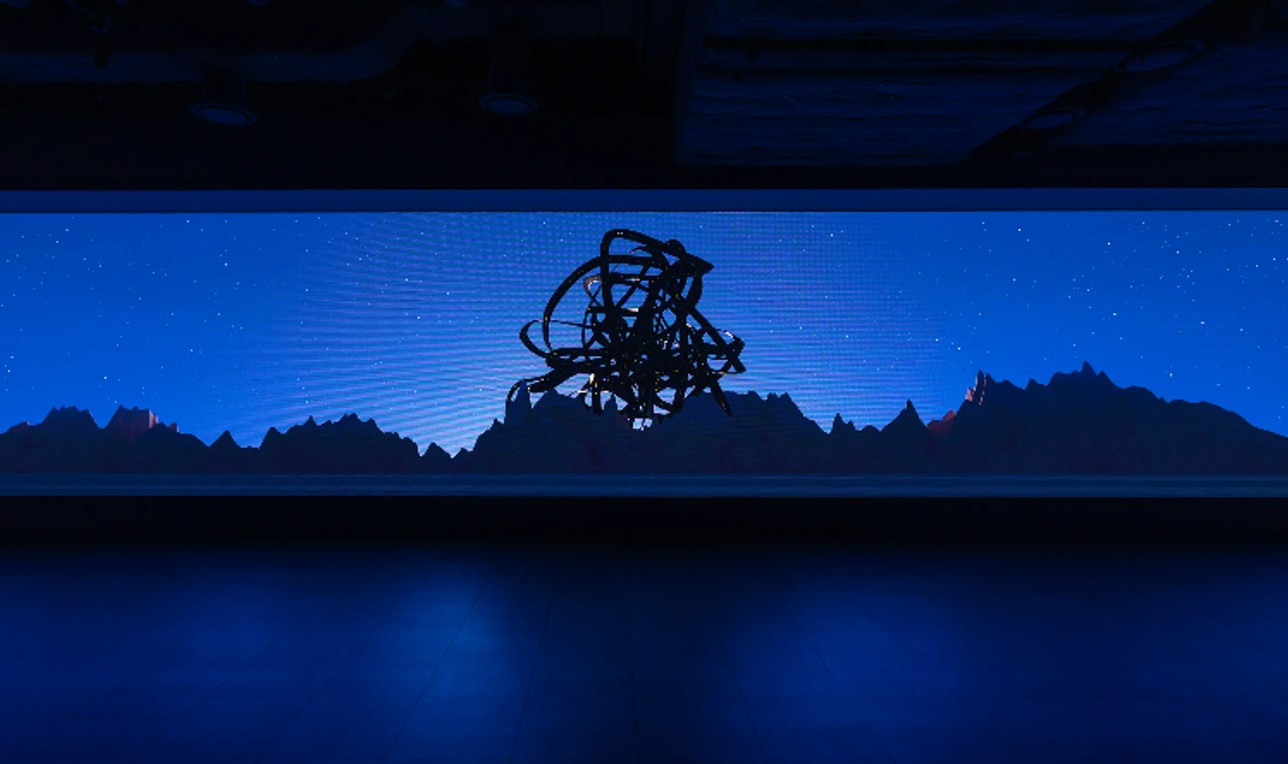
Minhyeok Seo, Post-Vanishing, 2026, single-channel video with sound, 2 min. 05 sec. / Photo courtesy of KAIST XD Lab.
3. Post-Vanishing :
The Post-Human City
Post-Vanishing imagines a city that persists after the disappearance of humankind.
Rather than depicting urban ruins, Minhyeok Seo proposes a nonhuman urban
environment capable of continuing beyond human presence. In doing so, the work
challenges anthropocentric conceptions of the city and encourages viewers to
reconsider urban space as a field jointly constituted by ecology, technology,
and nonhuman entities.
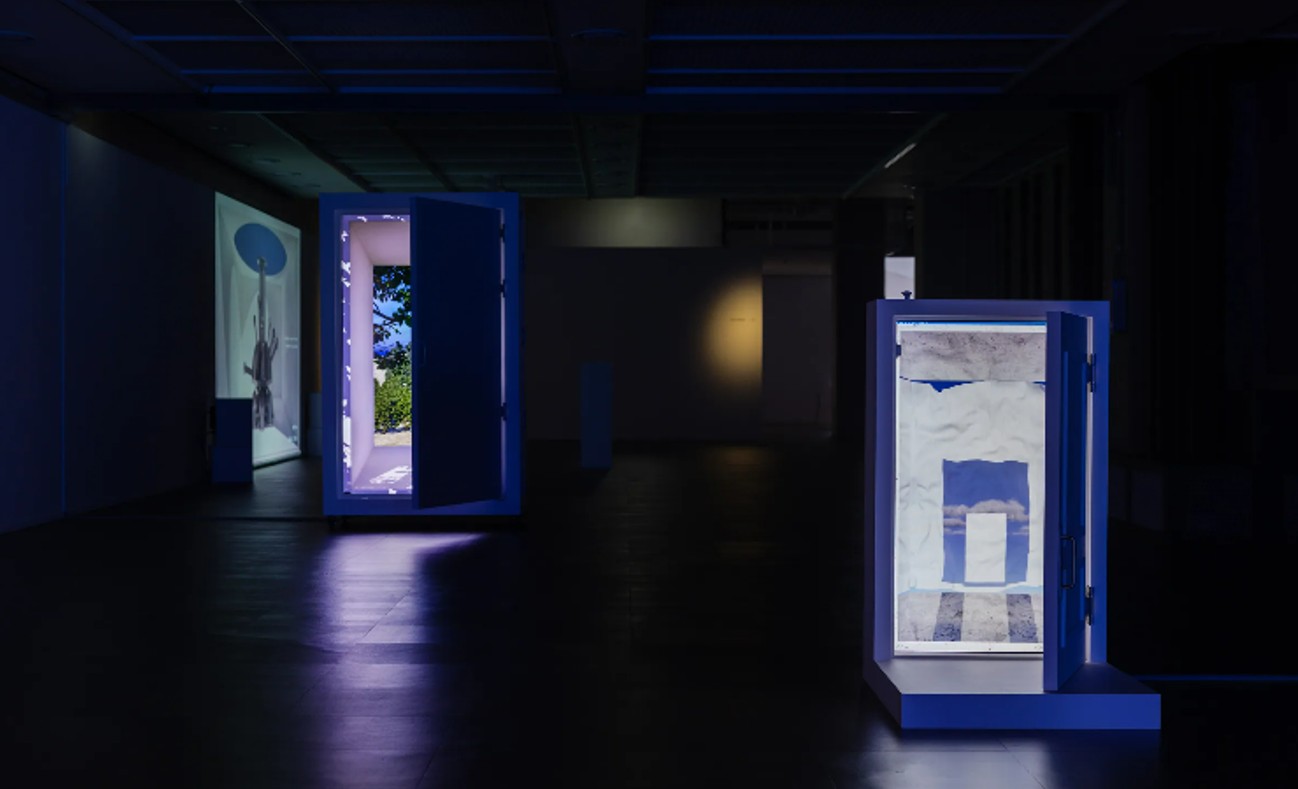
Minhyeok Seo, City’scape + Tied, 2026, small door, TV screen, single-channel video (1 min. 30 sec.); large door, TV screen, interactive installation, sound / Photo courtesy of KAIST XD Lab.
4. City’scape
+ Tied: The City as a Structure of Connections
Combining
physical doors, moving images, and audience interaction, City’scape
+ Tied presents the city not as a collection of buildings and
roads but as a complex structure woven from people, movement, memory, and data.
Through this installation, Minhyeok Seo interprets urban landscapes as networks
of relationships and flows rather than static images.
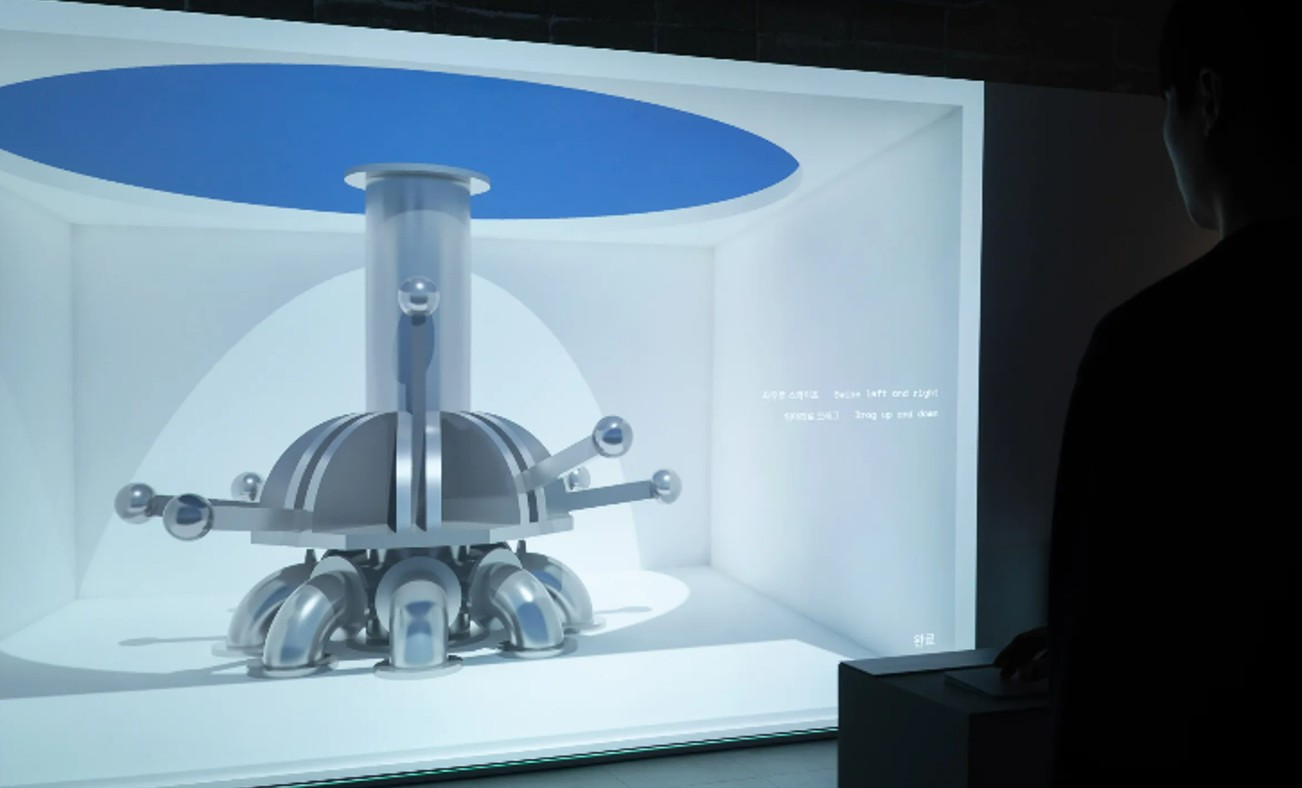
Intae Hwang, Goldilocks, 2025. Interactive installation, single-channel projection, sound, custom software. Supported by the Korea Foundation (KF). / Photo courtesy of KAIST XD Lab.
5. Goldilocks :
Weather and the Conditions of Urban Balance
Goldilocks is an interactive installation that allows visitors to construct
their own climatic conditions by manipulating seven meteorological variables—including
temperature, humidity, wind speed, cloud cover, visibility, rainfall, and
snowfall—and linking them to real-time weather data from Seoul. Through this
work, Intae Hwang demonstrates that environmental data are not abstract
numerical values but conditions directly connected to human life and urban
sustainability.
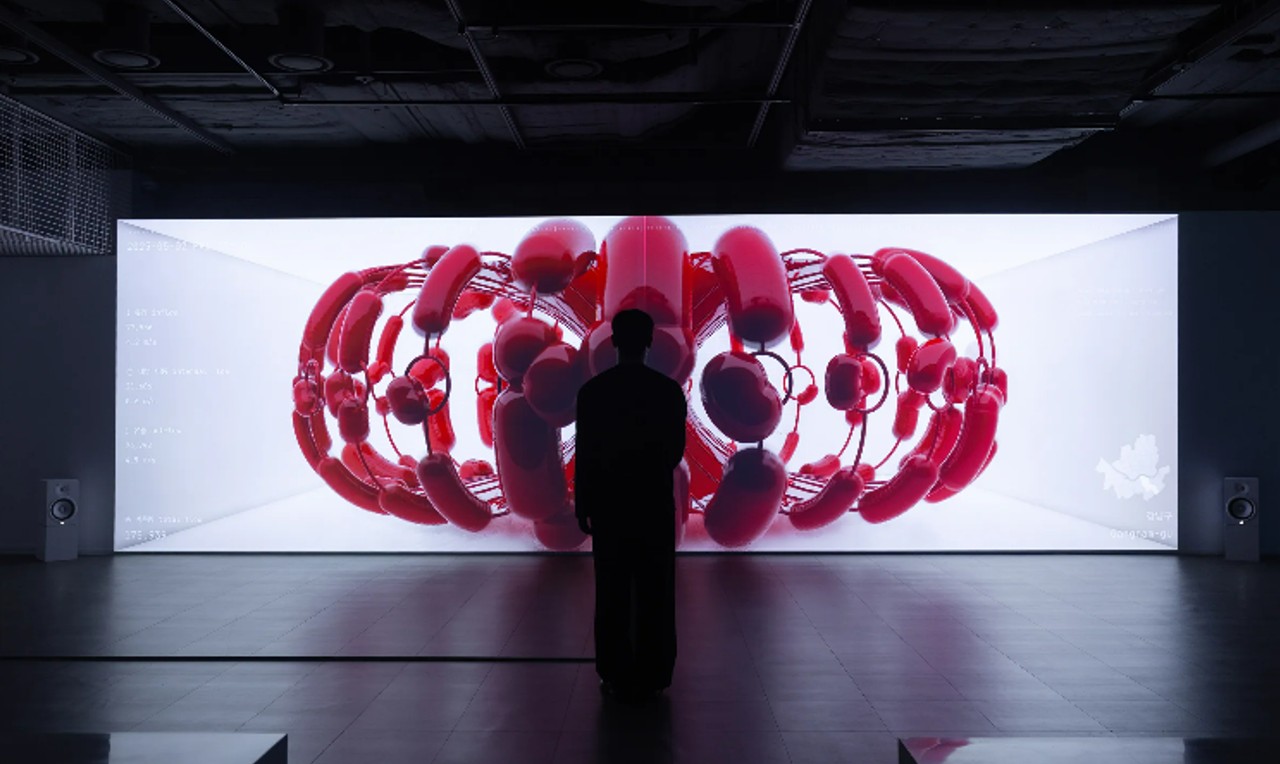
Interactive installation, two-channel projection, sound, pulse sensor, custom software./ Photo courtesy of KAIST XD Lab.
6. Vessel :
Connecting the Human Body and Urban Data
Vessel is a biofeedback-driven interactive installation that combines
bodily signals with real-time urban data. Intae Hwang links the physical
responses of visitors with the dynamic flows of city data, revealing that the
human body and urban environment are not separate systems but mutually
interactive structures.
Multi-device web-based artwork, four-channel video, participatory work involving viewers’ smartphones. / Photo courtesy of KAIST XD Lab.
7. Banpo
Xi-ism : Visualizing Urban Capital and Real-Estate Value
Banpo
Xi-ism is a multi-device web-based
artwork by Jeanyoon Choi. The work examines South Korea’s real-estate value
system through the lens of branded apartment culture. Through data-driven and
web-based formats, it analyzes the symbolic and economic structures produced by
branded apartment complexes. Urban space emerges not simply as a place of residence
but as a structure through which capital, desire, and social hierarchy operate.
Participating
Artists
Yiyun
Kang is a media artist whose practice
explores relationships among humans, technology, nature, and the environment.
In this exhibition, she expands discussions of urban ecology through works
addressing the Anthropocene, the technosphere, and posthuman cities.
Jeanyoon
Choi develops research-based projects
that connect science and technology with sociocultural systems. In Banpo
Xi-ism, she examines the structures of urban space and
real-estate value systems in contemporary Korea through a web-based format.
Intae
Hwang investigates relationships among
people, cities, and environments through data visualization, interactive media,
and experience design. In this exhibition, Goldilocks
and Vessel connect audience participation with urban
data systems.
Minhyeok
Seo focuses on digital environments,
future cities, and posthuman worlds. Through Post-Vanishing
and City’scape + Tied, he presents visions of urban
life that move beyond human-centered perspectives.
Public
Programs
As part of the
exhibition, “Artist Talk with KAIST XD Lab” will be held on June 20,
2026, with advance registration required. In addition, the participatory
program “The City I Draw“runs from May 9 through June 27, 2026. Further
information and registration details are available through Yeongdeungpo Art
Square’s official channels.
Exhibition
Information
《Living
Geometry 2026》
May 1 – June 28, 2026
Yeongdeungpo Art Square
B2F, Times Square, 15 Yeongjung-ro, Yeongdeungpo-gu, Seoul
Hours: Daily, 10:00 AM – 6:00 PM
Last Admission: 5:45 PM
Free Admission
Reservation: Not required
Concept &
Development: Experience Design Lab (XD Lab),
Department of Industrial Design, KAIST
Organizer: Yeongdeungpo-gu / Yeongdeungpo Art Square
Website: xdlab.net/events/living-geometry-2026