
In 1970, an
exhibition was forcibly dismantled at the Seoul National Public Information
Center. State authorities, who regarded avant-garde art as political agitation,
shut the room down. What remained were a handful of newspaper clippings, the
artist's notes, and fragments of memory.
This is the story
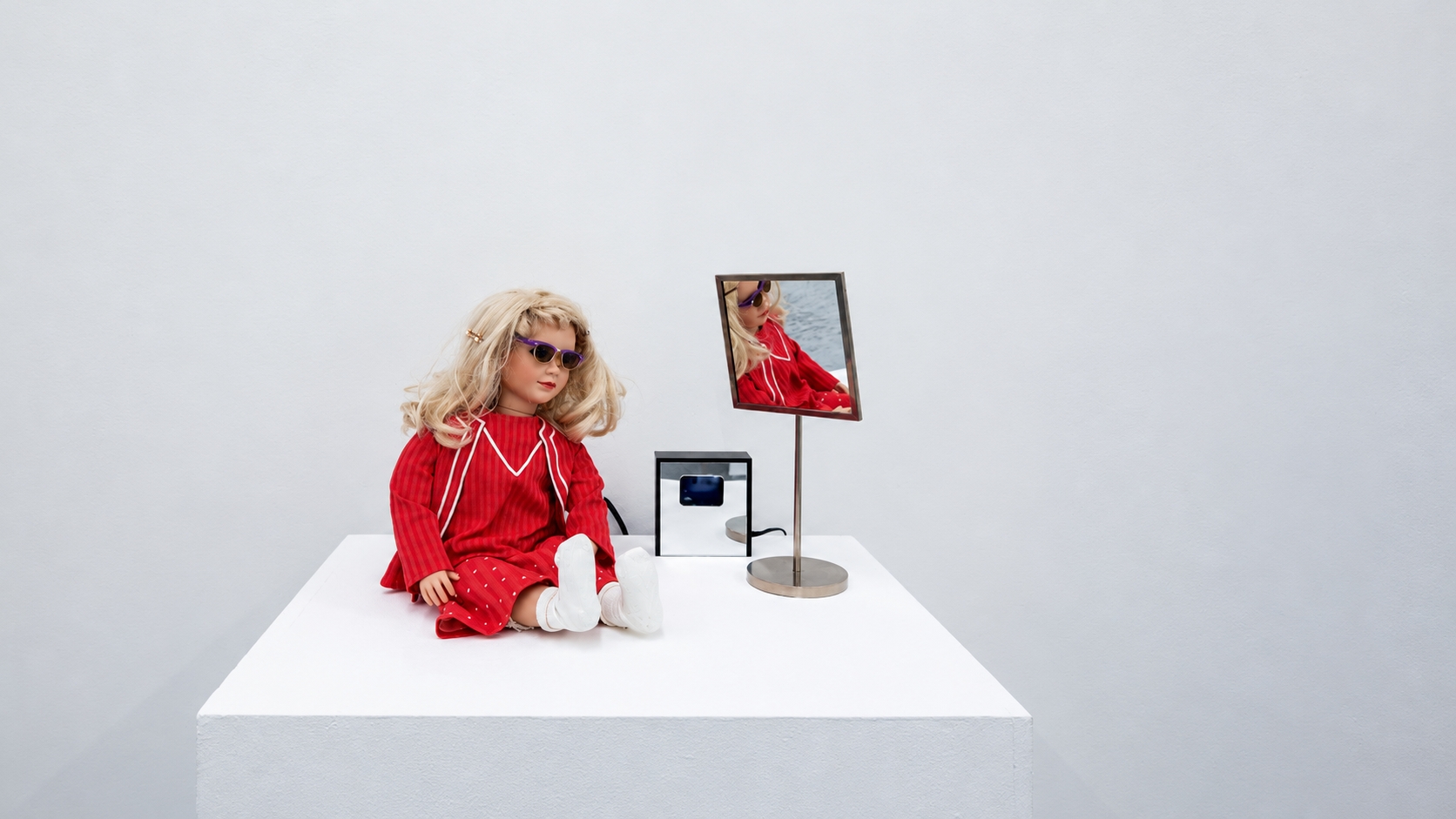
of Muchejeon (Incorporeal Exhibition), the first
environmental work attempted by Korean woman artist Jung Kangja. Leeum Museum
of Art has rebuilt that vanished room, fifty-six years later.
The exhibition《Inside Other Spaces: Environments by Women Artists 1956–1976》, now open at Leeum, is a project dedicated to restoring lost works
and forgotten names. Yet to describe it simply as "an exhibition
introducing overlooked women artists" falls short. More precisely, it is
an exhibition that asks us to reconsider an entire art form — one that was
always at risk of disappearing.
'Environment'
as Art, and the History of Its Disappearance
‘Environmental
art’(ambiente) is an experiential practice in which viewers enter the
work itself and encounter it with their whole bodies. Because each piece is
installed specifically for a given exhibition, it does not accumulate as a
physical object — once the show ends, the work is dismantled and ceases to
exist. An art form that cannot be hung on a wall, placed on a pedestal, or
sold, it existed entirely outside the grammar of institutional art.
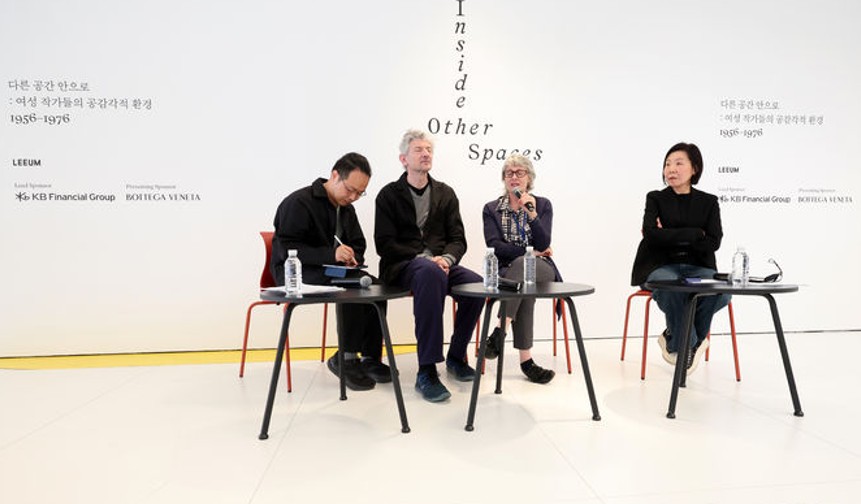
Andrea Lissoni, Artistic Director of Haus der Kunst (second from left), original curator of the Leeum Museum of Art’s international exhibition《Into Other Spaces: Sensory Environments by Women Artists, 1956–1976》; Marina Pugliese, Director of MUDEC in Milan (second from right); and Kim Sungwon, Deputy Director of Leeum Museum of Art (far right) / Photo: Newsis
Andrea Lissoni,
Artistic Director of Haus der Kunst, and Marina Pugliese, Director of Milan's
MUDEC, who first conceived the exhibition, described the history of
environmental art as "a history of destruction and disappearance."
Because the works of that era were experimental in nature and resistant to
preservation, women artists suffered a double erasure — written out of both art
history and the history of environmental art alike.
Paradoxically,
the very conditions that kept these women at the margins of institutional art
became a space of liberation, allowing them to experiment freely. Yet in a
male-dominated art history written around painting and sculpture, their work
was quickly forgotten.
Four
Years of Forensic Reconstruction: From Munich to Seoul
This exhibition
was originally conceived at Haus der Kunst in Munich in 2023, and has since
traveled and expanded through Rome's MAXXI (Museo nazionale delle arti del XXI
secolo) and Hong Kong's M+. Transformed and enriched at each stop, the
exhibition reaches its most fully realized form here at Leeum in Seoul.
To resurrect this
lost history, Leeum spent more than four years in a process of "forensic
reconstruction," tracking down correspondence, architectural drawings, and
critical writings from around the world. Director Lissoni described the process
as "closer to an investigation than an act of creation."
For living
artists, the team worked through direct dialogue; for those who had passed,
they pieced together evidence through families and archival materials. This was
not restoration in the sense of faithfully returning something to its original
state — it was a restoration that had to reckon with the fact that full
recovery is impossible.
The exhibition
spans roughly twenty years, from Tsuruko Yamazaki's Red,
shown at Japan's Gutai art exhibition in 1956, to the "Ambiente/Arte"
section of the 37th Venice Biennale in 1976. Works by eleven women artists —
Judy Chicago, Lygia Clark, Laura Grisi, Aleksandra Kasuba, Jung Kangja, Lea
Lublin, Marta Minujín, Tania Mouraud, Nanda Vigo, Tsuruko Yamazaki, and Marian
Zazeela — have been reconstructed at full scale.
Spaces
That Speak to the Body First
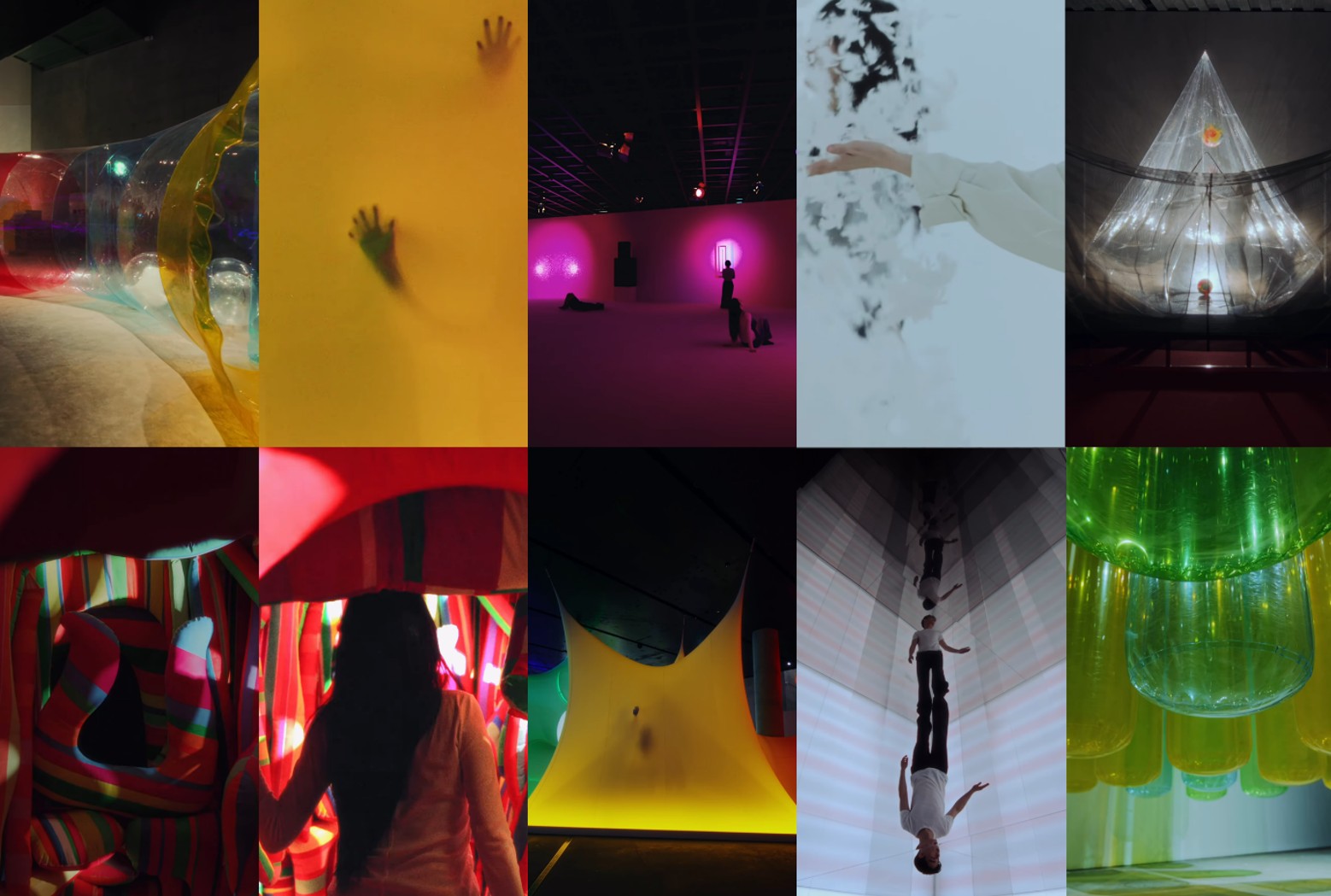
The first work to
arrest attention upon entering the exhibition is Aleksandra Kasuba's Spectral
Passage. Inside a sinuously curved structure that seems to blend
multiple geometric forms, layers of colored light spread through the space.
Visitors who step inside encounter the shifting interplay of light and
structure firsthand, experiencing it intuitively through movement.
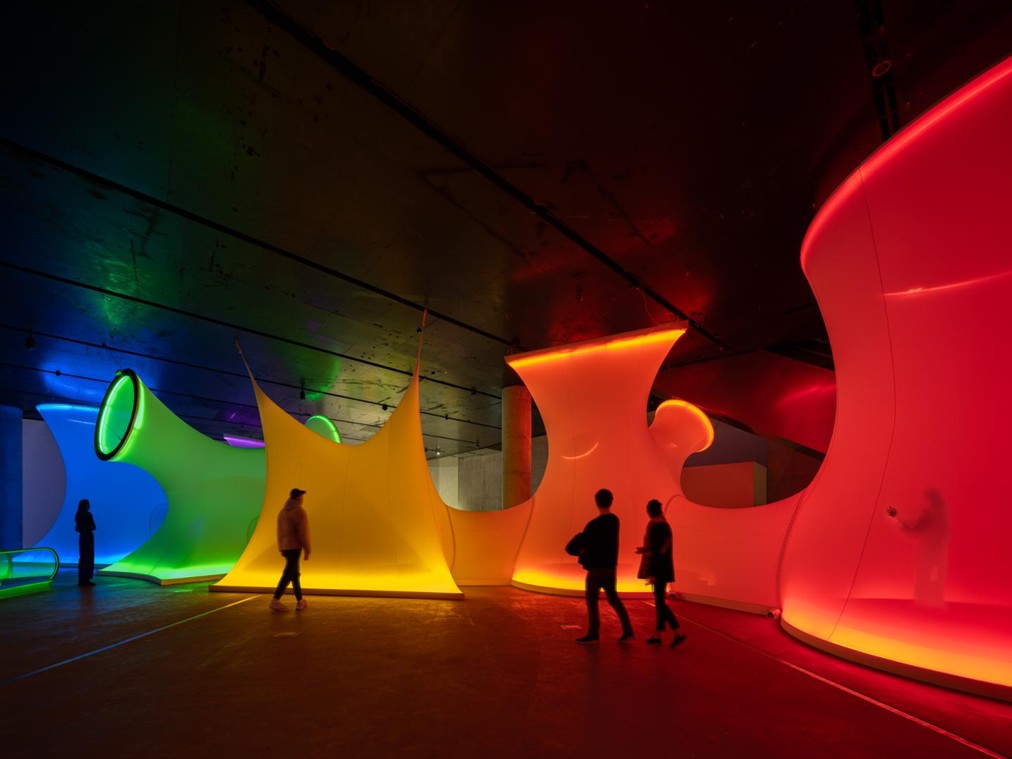
Spectrum Passage by Aleksandra Kasuba is a structural installation that uses nylon fabric and neon lighting to create a rainbow-colored passage symbolizing the journey of life. Photo: Leeum Museum of Art
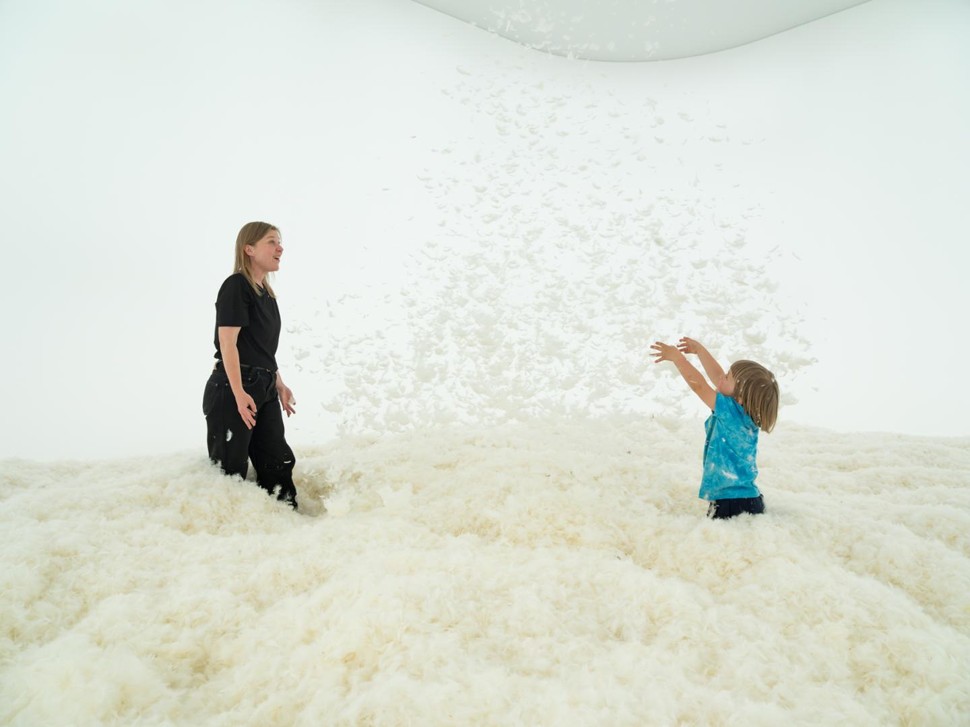
Judy Chicago's Feather
Room fills a curved white interior with tens of kilograms of
goose down. Moving through a space where feathers reach up to one's knees,
visitors are immersed in an otherworldly sensation — as if walking on clouds.
Conceived as a response to the male-dominated Minimalism of hard metals and
rigid structures, the work subverts the very sensation of space through soft,
warm materials.
Judy Chicago’s Feather Room, a large-scale installation filling an entire room with feathers. / Photo: Leeum Museum of Art
Tsuruko
Yamazaki's Red is a crimson structure that visitors
must lower their bodies to enter through a gap seventy centimeters above the
floor. Marta Minujín's Revuélquese y Viva (Wallow and Live!)
is a playful and provocative space constructed from mattresses, while Laura
Grisi's South-East Wind literally pushes visitors
back with real wind.
Lea Lublin's Teranotas
uses colored transparent vinyl to give form to the vaginal passage — an
intimate space of the female body — inviting visitors to traverse it
themselves. Particularly striking is the small child's T-shirt placed inside
the vinyl structure, evoking the wonder of life beyond the histories of erasure
and forced removal.
Exhibited works by the participating artists / Photo: Screenshot from Leeum Museum of Art’s Instagram
The
Exhibition's Crowning Achievements: Muchejeon (Incorporeal
Exhibition) and Dream House
The undisputed
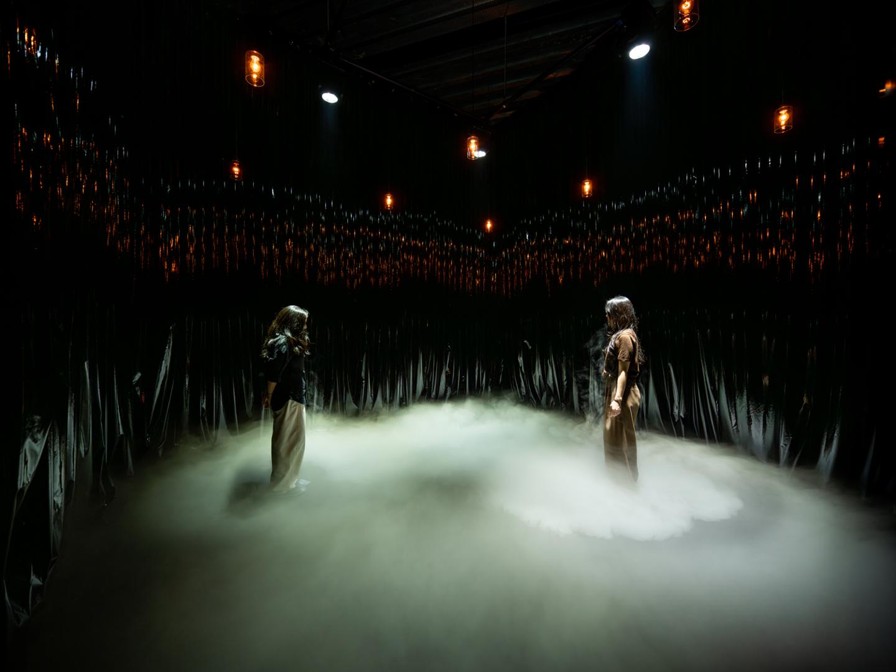
highlight of this exhibition is the reconstruction of Muchejeon
(Incorporeal Exhibition), by Jung Kangja — a pioneer of Korean
experimental art. Forcibly dismantled by the government in 1970, the work
returns for the first time in fifty-six years as a result of Leeum's meticulous
historical research combined with contemporary technology.
With no surviving
recordings of the artist's voice, Leeum used AI to reconstruct it from vocal
data provided by her family. The artist's voice, resonating through a darkened
chamber, transforms avant-garde art made sixty years ago into a living form in
the present.
Muchejeon (Incorporeal Exhibition) by Chung Kang-ja / Courtesy of Leeum Museum of Art
For this
exhibition, Leeum is also presenting Dream House — a
collaborative environmental work by Marian Zazeela, La Monte Young, and Jung
Hee Choi — for the first time in Asia. Combining light, sound, and space, the
work draws the time visitors spend within it into the work itself.
Bottega
Veneta and Leeum: A Third Partnership
The collaboration
between Bottega Veneta and Leeum Museum of Art marks the third such
partnership, following Kang Seo-kyung's《Willow Drum
Oriole》in 2023 and Pierre Huyghe's《Liminal》in 2025. Founded in 1966 in
Vicenza, in Italy's Veneto region, Bottega Veneta has maintained a close
relationship with artistic practice across architecture, design, dance, music,
and the visual arts since its earliest days.
A representative
of Bottega Veneta stated that the brand "supports work that embodies a
pursuit of excellence, communal values, and an original and progressive
approach to craft," and that by "backing projects where dialogue
across disciplines and geographies is at the center, we contribute to shaping a
broader artistic landscape."
In an era when
cultural sponsorship by fashion houses is often read as an extension of brand
image, this partnership reaches beyond simple sponsorship. Bottega Veneta's
core identity — rooted in craft and artisanal skill — is genuinely aligned with
the spirit of this exhibition: restoring the handcraft-based environmental art
of forgotten women artists to its rightful place.
The
Moment a Museum Becomes a Living Place
Kim Seong-won,
Deputy Director of Leeum Museum of Art, described the exhibition as one that
treats environmental art "not as a sealed-off historical genre, but as a
living form that moves between past and present," calling it "a
project that is both academically rigorous and art-historically significant,
while remaining accessible to a broad public."
The question this
exhibition ultimately poses is a single one: what does a museum choose to
preserve, and what does it choose to restore? Works that could not be sold,
that disappeared when their exhibitions ended, and that left behind barely any
records — if those works were erased more quickly because they belonged to
women artists, then what is happening here is not simply a historical act. It
is a declaration of what today's museum considers worthy.
The lost rooms
have returned. Across fifty-six years of time, these spaces have reopened — and
it is well worth stepping inside.
Exhibition
Information
- Title: Inside Other Spaces: Environments by Women Artists 1956–1976
- Venue: Leeum Museum of Art, Children's Education and Culture Center, 60-16
Itaewon-ro 55-gil, Yongsan-gu, Seoul
- Dates: May 5 – November 29, 2026
- Supported
by: Bottega Veneta, KB Financial Group
- Homepage: https://www.leeumhoam.org/leeum